

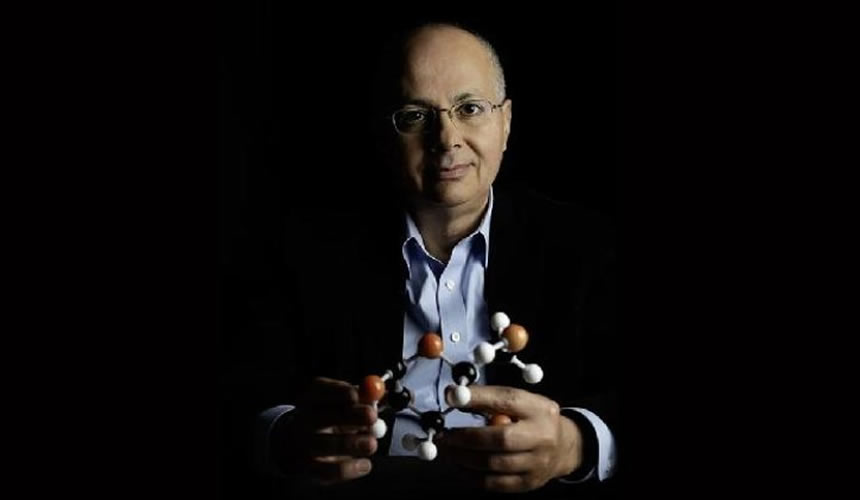
PSIPW wishes to congratute its laureate Professor Omar M. Yaghi of the University of California, Berkeley, for being awarded the 2025 Nobel Prize in Chemistry “for the development of metal-organic frameworks,” sharing the honor with Susumu Kitagawa of Kyoto University and Richard Robson of the University of Melbourne.
PSIPW wishes to congratute its laureate Professor Omar M. Yaghi of the University of California, Berkeley, for being awarded the 2025 Nobel Prize in Chemistry “for the development of metal-organic frameworks,” sharing the honor with Susumu Kitagawa of Kyoto University and Richard Robson of the University of Melbourne.
Metal–organic frameworks (MOFs), a term coined by Yaghi, are molecular constructions with large spaces through which gases and other chemicals can flow. By varying the building blocks used in the MOFs, chemists can design them to capture and store specific substances.
MOFs can be used to harvest water from desert air, capture carbon dioxide, store toxic gases or catalyse chemical reactions. They can also drive chemical reactions or conduct electricity.
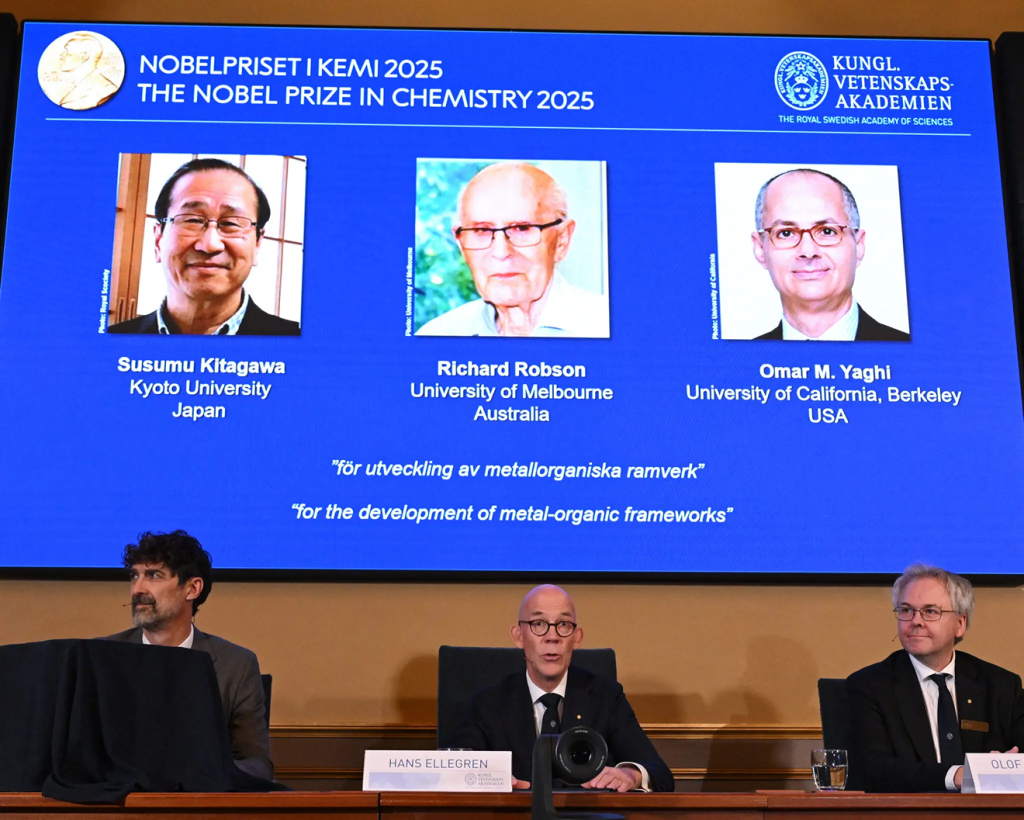 Hans Ellegren, Secretary General of Royal Swedish Academy of Sciences, announces the winners of the 2025 Nobel Prize in Chemistry
The particular achievement for which the Nobel Prize celebrates Yaghi is that he “created a very stable MOF and showed that it can be modified using rational design, giving it new and desirable properties.” This triggered a reovolution in chemistry which has allowed hundreds of thousands of MOFs to be developed with numerous valuable application.
In 2018, Omar Yaghi, in collaboration with Evelyn Wang of the Massachussetes Institute of Technology (MIT), won the Alternative Water Resources Prize in the the Prince Sultan Bin Abdulaziz International Prize for Water’s (PSIPW’s) 8th Award. They had created a solar-powered device that uses a MOF Yaghi developed to capture water from the atmosphere.
The device, which was constructed according to Yaghi’s vision with the assistance of Wang’s team at MIT, is capable of harvesting 2.8 liters of water per kilogram of MOF daily at relative humidity levels as low as 20%, operating passively without any power input, aside from ambient sunlight at a flux of less than 1 sun (1 kilowatt per square meter).
 In his PSIPW acceptance speech, Professor Yaghi described the importance of reticular chemistry, which he was instrumental in developing, and its application to water resources, saying:
“25 years ago, we embarked on a program to change the way we think about and make new materials. We discovered ways of stitching atoms and molecules with extraordinary precision to make materials in numbers and varieties never experienced before. This chemistry we call reticular chemistry has led to hundreds of thousands of new materials with millions of possibilities being pursued. These new materials are metal-organic frameworks (MOFs): Their structures are beautiful and their interior can be designed to seek water from air, store it in the pores, and concentrate it.
“By applying only ambient sunlight to such MOFs, water emerges from the pores that can be collected as pure liquid water.
“This is a revolution in the making and one we are exploiting to its fullest potential.”
The Nobel Prize announcement acknowledges this particular achievement, saying “Yaghi’s research group has harvested water from the desert air of Arizona. During the night, their MOF material captured water vapour from the air. When dawn came and the sun heated the material, they were able to collect the water.”


