


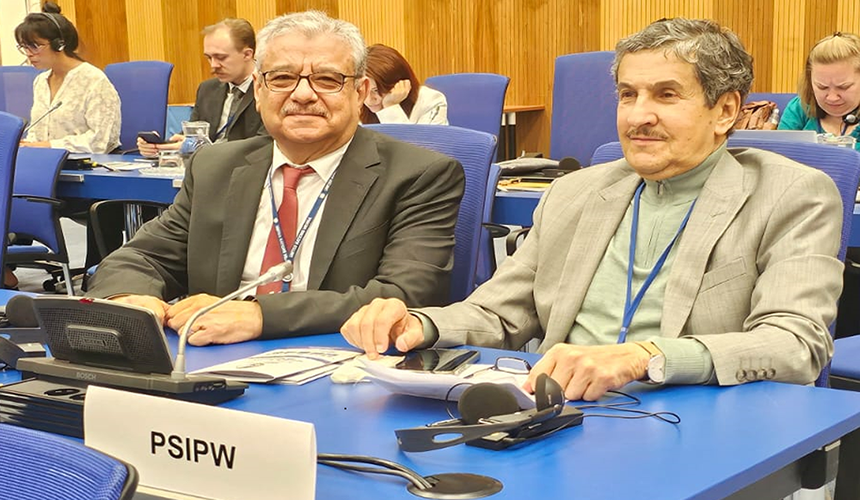
On 15 June 2026, the Prince Sultan Bin Abdulaziz International Prize for Water (PSIPW) made its public announcement for the winners of its 12th Award at the United Nations Office at Vienna (UNOV). The announcement took place at the water session of the 69th Committee on the Peaceful Uses of Outer Space (COPUOS).
This is in accordance with the approval of the Council of the Prince Sultan Bin Abdulaziz International Prize for Water (PSIPW) under the direction of PSIPW President HRH Prince Khalid Bin Sultan Bin Abdulaziz and in agreement with the recommendations of the international selection and referee committees of leading water scientists who evaluated the more than 275 nominations received from 69 countries.
The 12th Awards Ceremony will be held near the end of the year.
PSIPW is a leading, global scientific award focusing on cutting-edge innovation in water research. It gives recognition to scientists, researchers, and inventors around the world for pioneering work that addresses the problem of water scarcity in creative and effective ways.
To this end, PSIPW offers a suite of five prizes every two years, covering the entire water research landscape.
Nominations are currently open for the 12th Award (2026). Nominations can be made online for all five prizes directly through the PSIPW website: www.psipw.org
Leading international scientists with a diversity of backgrounds—including chemical engineering, civil engineering, Earth sciences, environmental engineering, physical geography, and GIS, as well as hydrology—won the five prizes for a wide variety of relevant, groundbreaking solutions that promise to help provide needed drinking water to the world’s people. The winners hail from institutions in Canada, China, Cyprus, Italy, and the United States.
Winners for the 12th Award (2026)
 Creativity Prize: The team led by Mohamed S. Ghidaoui (Hong Kong University of Science & Technology, HKUST, China) and Silvia Meniconi (University of Perugia, Italy).
The work of this interdisciplinary team from China and Italy involves transforming the time reversibility of hydraulic waves into a powerful diagnostic framework to monitor water infrastructure health.
Team members include Bruno Brunone (University of Perugia, Italy), Moez Louati (HKUST, China), Xun Wang (formerly with HKUST and currently with Beihang University, China), and George Grigoropoulos (formerly with HKUST and currently with Ove Arup & Partners Hong Kong Ltd., China).
Additional team contributors include Muhammad Waqar (formerly with HKUST and currently with Hong Kong Metropolitan University, China), Saber Nasraoui (formerly with HKUST, China, and currently with University of Tunis, Tunisia), and Fedi Zouari (formerly with HKUST and currently with Hong Kong Telecom, China).
 Creativity Prize: The team of James Famiglietti (Arizona State University, USA)
The team’s work is centered on transforming satellite gravimetry from the GRACE and GRACE-FO missions into a practical tool for monitoring groundwater depletion and terrestrial freshwater change.
Team members include Hrishikesh Chandanpurkar, Karem Abdelmohsen (Arizona State University); Matthew Rodell, Pang-Wei Liu (NASA Goddard Space Flight Center); and John T. Reager (NASA Jet Propulsion Laboratory/Caltech).
 Surface Water Prize: Jeffrey McDonnell (University of Saskatchewan, Canada)
McDonnell’s work involves integrating fieldwork and isotope hydrology to advance surface water hydrology and the discovery of new hydrological and ecohydrological processes. Using stable isotope tracers, his research addresses the fundamentals of how catchments store and release water and the interplay between streamflow and evapotranspiration, providing robust new model structures for surface water prediction.

 Groundwater Prize: The team of Scott Jasechko & Debra Perrone (University of California Santa Barbara, USA)
Their work represents the most comprehensive observational assessment of groundwater resources ever assembled at the global scale, using real-world observational data to provide the most detailed empirical picture to date of the state of global groundwater resources. In doing so, they address several of the most pressing questions in modern hydrogeology: groundwater depletion, the vulnerability of wells to falling water tables, the interactions between groundwater and surface water systems, and the increasing exploitation of fossil groundwater reserves.
 Alternative Water Resources Prize: Despo Fatta-Kassinos (University of Cyprus)
Fatta-Kassinos has redefined how the safety of treated wastewater and reclaimed water is assessed. Her pioneering work integrates advanced treatment, micropollutant and transformation-product abatement, microbiological water quality, antimicrobial resistance, and environmental sustainability into holistic frameworks for safe water treatment and reuse. Using this integrated chemical–biological framework, she demonstrates how antibiotics and other micropollutants, their transformation products, microbial communities, and resistance-related risks must be assessed as parts of one connected system. This has helped move the field beyond conventional water-quality testing toward a more realistic understanding of what it means for reclaimed water to be truly safe.
 Water Management & Protection Prize: The team of Xin Li (Institute of Tibetan Plateau Research, Chinese Academy of Sciences)
Xin Li and his team have developed a new paradigm for basin-scale integrated ecohydrological research in cold and arid regions, overcoming the traditional divide between eco-hydrological models focused on natural processes and water-policy or economic models oriented towards management decisions. They demonstrate that a meaningful understanding of arid basins—characterized by strong dependence on irrigation, groundwater stress, and ecosystem fragility—requires tools capable of simultaneously representing cryospheric dynamics, recharge and runoff processes, surface–groundwater interactions, vegetation evolution, agricultural decision-making, water-allocation policies, and the choices of economic actors.
Team members include Kun Zhang (Sun Yat-sen University, China), Ling Zhang, Yingchun Ge, and Guodong Cheng (Northwest Institute of Eco-Environment and Resources, Chinese Academy of Sciences).


